CHAPTER 01 // ROUTINES & CADENCE

Build Your Wash Rhythm

There is no virtuous number of days to wait between hair washes. A runner in humid Gothenburg needs a different rhythm than an office worker with high-porosity curls in dry northern winter air. Here is how to calibrate cleansing, conditioning, and drying without cluttering your bathroom ledge.

MODULE 1.1 // TEXTURE COMPARISON MATRIX

Calibrate by Fiber Width and Pattern

Many people confuse Nordic hair care with care exclusively for fine, pin-straight blonde strands. In reality, modern Scandinavian cities are home to every curl pattern and fiber thickness, united by a shared climate of extreme light shifts, hard or ultra-soft municipal water, and indoor heating. Use this matrix to locate your mechanical baseline.

Fiber Profile Typical Sebum Mobility Ideal Wash Cadence Conditioning Placement Key Seasonal Adjustment
Fine & Straight / Soft Wave
(Small cross-section, smooth cuticle)
Fast—scalp lipids travel down the shaft within 24–36 hours Every 1–2 days with mild amphoteric/anionic blend Strictly mid-lengths to ends; rinse thoroughly after 60 seconds Use lightweight panthenol mist in winter to stop static flyaways without flattening roots
Medium & Wavy / Loose Curl
(Elliptical follicle, moderate S-bend)
Moderate—roots feel fresh for 2–3 days while ends dry out Every 2–4 days; occasional water-only scalp refresh after light exercise Squish water and lotion-weight conditioner into dripping ends Switch from glycerin-heavy gels in damp autumn to flexible acrylate/starch foams
Coarse & Curly
(Pronounced spiral, raised cuticle at bends)
Slow—natural oils struggle to navigate spiral turns Every 4–7 days; use moisturizing shampoo or cleansing cream Apply rich cetearyl alcohol mask from two inches below roots; detangle wet Seal damp curls with lightweight squalane or oat lipid oil before stepping into freezing air
Coily & High-Shrinkage
(Tight Z/S coils, fragile elliptical points)
Very slow—high surface area loses moisture rapidly to dry air Every 7–10 days in sections to prevent tangling at the root Pre-shampoo oil buffer on ends, followed by warm deep conditioning Humidify bedroom air during radiator season (aim for 40–50% indoor RH)
THE TWO-SHOWER-BOTTLE PRINCIPLE

One Daily Cleanser, One Monthly Reset

Instead of rotating five half-empty shampoos, keep one gentle surfactant formula for 90% of washes and one chelating/clarifying wash for removing hard-water calcium, swim chlorine, or heavy styling waxes.

MODULE 1.2 // NUMBERED TUTORIAL BLOCKS

Three Practical Wash Protocols

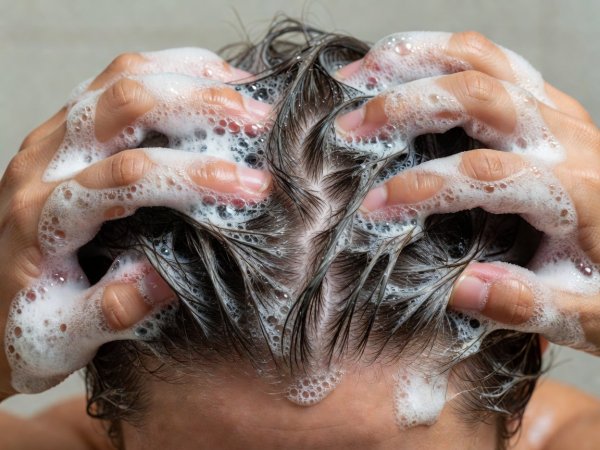
PROTOCOL 01 // 6 MINUTES Close-up of fingertips massaging emulsified shampoo foam strictly across the scalp crown
The Weekday Commuter Wash

Designed for mornings after cycling, gym sessions, or sleeping in warm rooms when you need clean roots without spending twenty minutes styling.

  1. Soak thoroughly (60 sec): Let lukewarm water drench the scalp so you use half as much shampoo.
  2. Palm-emulsify & zone wash (90 sec): Rub a coin-sized drop of shampoo between wet palms first, then press directly onto the hairline, crown, and nape. Let the rinse water clean the lengths.
  3. Ear-down flash condition (90 sec): Smooth a walnut-sized amount of conditioner from ear level to tips, comb through once with wide teeth, and rinse cool-to-warm.
  4. Microfiber press (60 sec): Squeeze—do not twist—excess water out before applying a pea-sized leave-in cream.
Review Scalp Massage Mechanics →
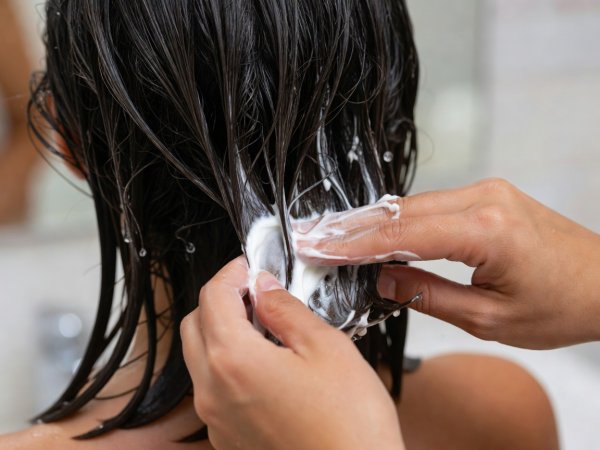
PROTOCOL 02 // 15 MINUTES Shallow depth close-up of hands smoothing white conditioning cream onto wet hair ends in sections

The Winter Pre-Condition Buffer (C-W-C)

When sub-zero air or bleached highlights leave your ends tangling during shampooing, Condition-Wash-Condition shields fragile mid-shafts from surfactant friction.

  1. First coat (2 min): On wet hair, glide a basic rinse-out conditioner over the bottom third of your hair. Do not rinse yet.
  2. Scalp cleanse (2 min): Apply shampoo strictly to the scalp roots and massage gently with finger pads.
  3. Unified rinse (1 min): Rinse everything together; the first conditioner coat blocks surfactant stripping on the oldest ends.
  4. Second seal (5 min): Apply your primary mask or conditioner from mid-shaft down while completing your shower routine, then rinse cleanly.
See Best C-W-C Conditioners →
MODULE 1.3 // SEASONAL CHECKLIST

Water Quality & Drying Habits

Hard Water vs. Soft Water Regions

In limestone-rich areas such as Copenhagen or southern Skåne, tap water carries high levels of calcium and magnesium ions (often above 15 °dH). These minerals react with fatty acids in sebum and conditioners, leaving a dull, waxy coating that weighs down fine hair and blocks moisture from entering curls. Conversely, granite-bedrock cities like Oslo or Stockholm have very soft water, where shampoo lathers intensely and rinses away rapidly.

  • In hard-water zones, look for shampoos containing Disodium EDTA, Phytic Acid, or Sodium Gluconate every third wash.
  • In soft-water zones, cut your shampoo dose in half to avoid endless rinsing and over-cleansing.
  • Never go to bed with soaking-wet hair in winter; prolonged hygral fatigue swells the cortex and encourages scalp yeast growth against warm pillows.
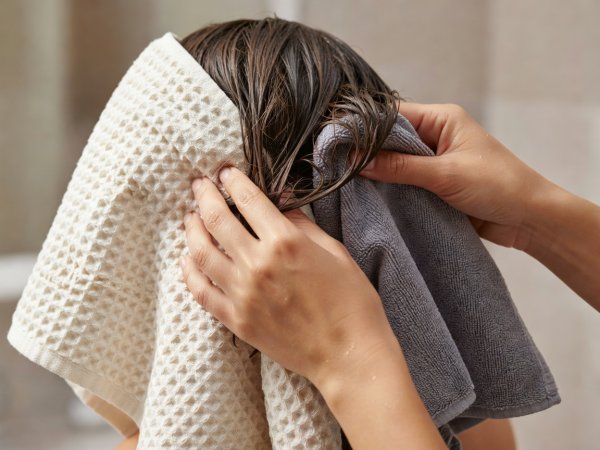
Close-up of hands gently pressing damp hair sections between folds of a waffle-weave towel

Waffle-weave cotton or flat microfiber absorbs surface water via capillary action without ruffling cuticle scales.